
Blog
How to Choose the Right Mixer Powder for Your Business?
Choosing the right Mixer Powder system starts with the material, not the catalogue. A fine, dusty blend behaves differently from coarse granules, even when both fit the same tank. Particle size, moisture, bulk density, and flowability can change mixing time and final uniformity. Small details matter. A scoop of powder clinging to a wall can signal a costly process problem.
Grand View Research’s Industrial Mixers Market report maps demand across sectors such as food and beverage, chemicals, and pharmaceuticals. That spread matters: each application brings different requirements for batch size, cleaning, temperature control, and product consistency. The report offers useful market context, but it cannot tell a business which machine will perform best with its own materials. Testing remains essential.
Professor John Bridgwater, a leading researcher in powder mixing, has emphasized that successful blending depends on material properties, mixer design, and operating conditions working together. That is a practical reminder, not a promise of one perfect machine. A ribbon blender may suit one free-flowing blend, while a paddle or high-shear mixer may better handle another. I would not choose from motor power alone. It is tempting, but incomplete. Before investing, compare trial results, cleanability, throughput, and maintenance needs using representative batches. A short pilot run can reveal dead zones, dust, or inconsistent samples that a brochure will never show. Your best choice is the one that meets the process requirements reliably, batch after batch.
Define Your Business Needs and Intended Applications
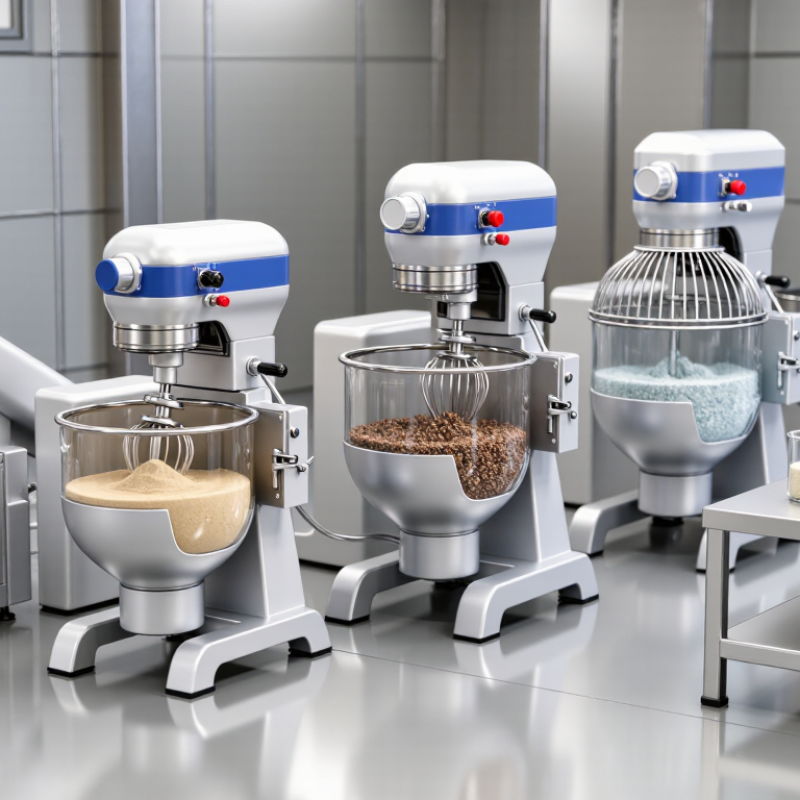
Start with the job the powder must do. Is it being dispersed, blended evenly, or combined with a liquid? A fine, dusty ingredient behaves differently from coarse granules or a damp, cohesive powder. Record your usual batch size, peak demand, target mixing time, and acceptable variation. Include the smallest batch, too; a mixer that performs well when full may struggle with a partial load.
The intended application sets the priorities. Food and beverage businesses may need repeatable recipes and easy cleaning between batches. Construction materials may require a robust machine for dense, abrasive powders. For sensitive ingredients, ask suppliers for test runs using your actual materials. Check whether the mixer can handle changes in particle size, moisture, and bulk density. A specification sheet alone can miss these details.
Waste data offers useful context, though it is not mixer-performance data. UNEP’s Food Waste Index Report 2024 estimates that 1.05 billion tonnes of food were wasted in 2022, around 19% of food available to consumers. For food businesses, this is a reminder to examine batch sizing and process control, not proof that a mixer alone reduces waste. Write down your assumptions, then challenge them. A checklist helps, but it will not catch everything.
Identify Mixer Powder Types and Their Key Ingredients
“Mixer powder” can mean very different things: an instant beverage base, a protein blend, or a baking premix. Start with the job it must perform. Beverage powders often combine sugar or maltodextrin with cocoa, flavorings, and an emulsifier for quick dispersion. Protein blends may use whey, casein, soy, pea, or rice proteins. Baking mixes rely more on flour, starch, leavening agents, salt, and sometimes dried egg or milk. Small details matter. A powder that looks fine in a sample jar may clump when poured into cold water.
For dairy-based blends, the OECD-FAO Agricultural Outlook 2024–2033 projects global milk production to grow about 1.5% annually over the coming decade. That supply context makes dairy protein availability worth checking, but it does not guarantee stable local pricing. Compare protein content, moisture, particle size, and dispersibility on the supplier’s specification sheet. Then test a small batch using your actual mixer, liquid temperature, and serving process. The awkward part: a “clean” ingredient list can still produce a gritty drink or weak foam. Plant proteins may need flavor masking; added lecithin can improve wetting, but may change texture. Choose ingredients against measurable needs, not a label claim alone.
Compare Performance, Compatibility, and Quality Standards
How to Choose the Right Mixer Powder for Your Business?
Compare Performance, Compatibility, and Quality Standards
A mixer powder can look uniform in a scoop and still separate during transport. Compare particle size, bulk density, moisture, and flow behavior with your process conditions. ASTM E11-24 lists a 75-micrometer opening for a No. 200 sieve, a useful reference when checking particle-size data. But one sieve result cannot describe the entire particle distribution. Small differences matter.
Test the powder in the mixer you actually use. Record blend time, discharge consistency, and any buildup around blades or vessel corners. Check whether humidity changes flow, or whether vibration causes fine particles to settle.
No single test settles it. A small pilot batch may reveal problems that supplier specifications miss, though pilot results may not perfectly predict full-scale production.
Compatibility includes equipment materials, cleaning methods, packaging, and storage conditions. For food applications, review allergen controls and applicable food-safety requirements. Request a certificate of analysis, batch traceability, and documented test methods.
The FDA’s 2011 Process Validation guidance describes three stages: process design, process qualification, and continued verification. Its framework is a useful reminder that initial approval is not ongoing proof.
I would still question a powder that passes paperwork checks but performs inconsistently on the production line.
Assess Costs, Suppliers, and Storage Requirements
Choosing a mixer powder starts with the cost per usable batch, not just the price per bag. Compare shipping, minimum order quantities, and the recommended mixing rate. A powder that costs more may produce more finished product or dissolve faster, reducing labor. Ask suppliers for recent batch specifications, sample availability, and typical lead times. Check whether they can explain changes in color, flow, or moisture between batches. A spreadsheet helps, but it cannot predict every delay.
Tips: Request a small sample. Test it with your actual equipment and water conditions. Record mixing time, residue, and output. Check that delivery dates fit your production schedule.
Storage can quietly affect both quality and cost. Review the supplier’s handling guidance, then confirm your space stays within the stated temperature and humidity range. Keep bags sealed, raised off the floor, and away from damp walls. Label each delivery with its arrival date, and use older stock first. This sounds basic, yet busy teams can miss it. I’d leave room for a small trial order before committing; forecasts are useful, but sometimes imperfect. A reliable supplier should answer practical questions clearly and flag storage limits before purchase.
Run Product Trials Before Making a Final Selection
A mixer powder that looks uniform may still separate during filling. Run small, controlled trials with the actual ingredients, batch size, and process steps. Record mixing time, load level, temperature, and discharge order. Take samples from several points, including the outlet and the bottom of the vessel. Small details matter.
Use measurable checks, not appearance alone. For powders intended for dosage forms, United States Pharmacopeia General Chapter <905> sets an acceptance value of 15.0 at Level 1, based on testing 10 units. This is a dosage-unit uniformity criterion, not a universal mixer specification. Still, it shows why sampling and defined limits matter. For other products, agree on suitable tests with your quality team before trials begin.
Compare results across repeated runs. Check blend consistency, residue on vessel walls, dust, cleanout time, and whether the powder flows steadily through your downstream equipment. Keep one trial deliberately practical: use the operators, tools, and cleaning routine your plant can sustain. A perfect laboratory result may not survive a rushed production shift. We can overvalue a single successful batch; repeatability deserves more weight.
Related Posts
-
How to Choose the Best Mixing Powder Machine in China?
-
How to Choose the Best Powder Milk Mixer for Your Needs?
-
Why Choose a Mixing Powder Machine for Your Business?
-
China Top Powder Mixture Machine Manufacturers for Global Buyers
-
What Are the Best Powder Mixers from China?
-
China Best Powder Milk Mixer for Global Suppliers?