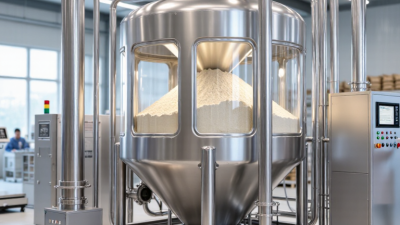
How to Choose the Best Mixing Powder Machine in China?
Choosing the best Mixing Powder Machine in China starts with the material, not the catalogue. A fine, dry flour behaves differently from damp granules or a blend containing fragile particles. Those differences affect mixing time, uniformity, dust control, and cleaning. Small details matter: a discharge valve that leaves residue can create costly rework.
Industry reports offer useful context, but forecasts are not buying specifications. Grand View Research estimated the global industrial mixer market at USD 2.43 billion in 2023 and projected 5.5% annual growth from 2024 to 2030 (Industrial Mixer Market Size, Share & Trends Analysis Report). Mordor Intelligence’s industrial mixer market analysis also examines demand across sectors such as food, chemicals, and pharmaceuticals. These broad figures signal continued investment in mixing equipment; they do not prove that one machine suits every plant.
For a China-based purchase, compare the working volume with actual batch size, then ask for test results using your own powder. Request details on motor power, contact-part materials, seals, control options, and cleaning access. Ask the supplier to show how uniformity was measured, and whether the test conditions match your process. A polished sample is not enough. Sometimes the overlooked issue is simple: can operators inspect and clean the vessel without awkward steps? Supplier claims deserve verification, and I would treat any promised mixing time as provisional until a representative trial confirms it.
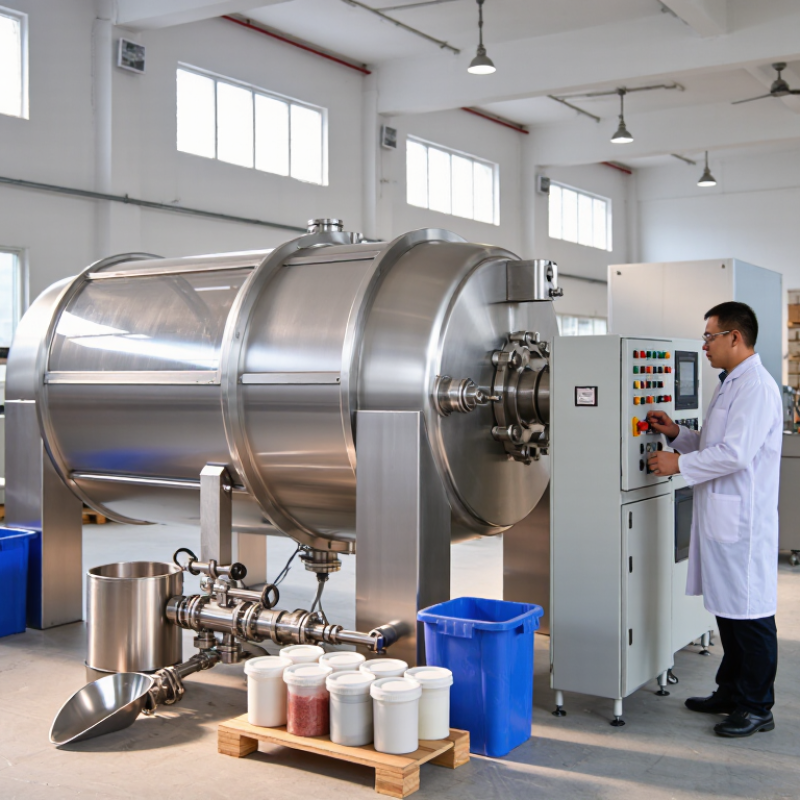
Characterize Powder Inputs with D10, D50, D90, Bulk Density, and Moisture
How to Choose the Best Mixing Powder Machine in China?
Start with a representative powder sample, not a catalogue promise. ISO 13320:2020 describes laser diffraction for particle-size analysis. D10, D50, and D90 mark the sizes below which 10%, 50%, and 90% of measured particles fall. A lot report might show
D10 45 μm,
D50 180 μm, and
D90 420 μm.
Treat these as example values, not a universal target. A wide spread can signal segregation risk, while fine particles may cling to mixer walls. Small shifts matter.
Record bulk density and moisture alongside the size distribution. ASTM D7481 provides methods for measuring loose and tapped bulk density; these values can differ, so state which one the supplier measured. For example, a report might list 0.62 g/cm³ and 1.8% moisture. Those figures alone cannot predict mixing quality. Test the powder at its expected storage and operating conditions, then check for lumps, dust, and discharge problems. I would still question a neat lab number: sampling error is easy to overlook. A short production trial can reveal behavior that a datasheet misses.
Match Mixer Type and Batch Size to a Typical 30–70% Working Fill
Match the mixer to the powder and the batch, not just the vessel’s advertised capacity. A practical starting point is a working fill of 30–70% of total volume; it is a sizing window, not a universal limit. The 9th edition of Perry’s Chemical Engineers’ Handbook and AIChE mixing guidance emphasize that mixer geometry and operating conditions affect performance. A ribbon mixer often needs room for circulation, while a tumble blender relies on powder movement through the vessel. At very low fill, the blades may not engage enough material. At high fill, mixing can become uneven.
Estimate batch volume from bulk density: divide batch mass by the powder’s measured bulk density, then compare that volume with the mixer’s working range. For example, a 100 kg batch at 0.5 kg/L occupies about 200 L before allowance for headspace. Test the actual blend when possible. Particle size, moisture, and flowability can change the result. The calculation is useful, but it can still be wrong.
Tips: Ask for a trial with your powder. Check samples from different points in the batch, and record mixing time and fill level. Leave room for expansion or aeration; a neat spreadsheet cannot predict every powder’s behavior.
Set a Blend-Uniformity Target, Such as CV ≤5%, and Define Sampling
When comparing mixing powder machines in China, define uniformity before requesting a quotation.
Set a target such as CV ≤5%, then state how it will be measured. CV is the standard deviation divided by the mean, expressed as a percentage. Treat 5% as a process goal, not a universal regulatory limit. The FDA’s 2003 guidance, Powder Blends and Finished Dosage Units, emphasizes representative sampling and assessment. USP General Chapter <905> uses an acceptance value limit of 15.0 for dosage-unit uniformity; that finished-product measure is not a blend-CV target. The distinction matters.
Write the sampling plan into the machine trial protocol. Take separate samples from defined positions, such as the upper, middle, and lower powder bed, and from the discharge at the beginning, middle, and end. Record each location and assay result; a single composite sample can hide local variation. Keep sample mass and handling consistent, since a thief or scoop may disturb the powder. Ask suppliers to test your actual ingredients, batch size, and loading level, not just an easy demonstration blend. I would hesitate to approve a machine from one good run. That is weak evidence. Repeat runs and review the individual results, not only the average CV.
Compare Throughput, Mixing Time, Power, and Cleanout Data Across Models
When comparing mixing powder machines in China, ask for throughput under a stated batch size, not a headline figure alone. A machine rated for 500 kilograms per hour may deliver less with a fine, dusty blend or a cautious loading cycle. Check whether the quoted rate includes feeding and discharge. Small details matter.
Mixing time should come from a defined test: ingredient ratios, batch weight, and the point at which uniformity was measured. Request the sampling method or test report, then compare results across models using the same recipe. A short cycle is not automatically better. Overmixing can waste energy or affect fragile particles, while inconsistent sampling can make a weak result look convincing.
Compare installed power and actual operating load together. Record motor kilowatts, typical cycle duration, and energy use per batch if available. Ask operators to demonstrate cleanout after a realistic run, including corners, seals, and discharge openings. Photograph any residue on surfaces. Cleanout time is often omitted, yet it affects changeovers and labor. Data may not be perfectly tidy; suppliers may use different test conditions. Put those differences in the comparison sheet, and request a witnessed trial when the figures remain difficult to reconcile.
Verify Supplier Testing and Electrical Safety to GB/T 5226.1-2019
When choosing a mixing powder machine in China, ask the supplier how its electrical safety checks relate to GB/T 5226.1-2019. The standard covers electrical equipment of machinery, but a certificate alone does not prove that the exact machine you will receive was tested. Check that the report identifies the model, control cabinet, rated voltage, and test date. Paper claims are not enough.
Request records for protective bonding, insulation resistance, and dielectric-strength tests, where applicable. Ask to see the wiring diagram and confirm that the emergency stop, motor overload protection, and isolating switch work during a witnessed factory test. Look inside the cabinet: labels should be readable, wires secured, and cable entries protected from abrasion. For dusty production areas, discuss enclosure suitability and cleaning methods with the supplier. Do not assume a standard machine suits every site.
Compare the test report with the machine’s nameplate and the electrical supply at your facility. If voltage, frequency, or control components differ, ask what changes require retesting. A tidy certificate still leaves questions. Test procedures and acceptance criteria may vary by configuration, so have a qualified electrical professional review unclear records before shipment.