
Leave Your Message
Blog

Blog

China Top Powder Mixture Machine Manufacturers for Global Buyers

China has become an important sourcing base for powder processing equipment, but choosing a supplier takes more than comparing catalog prices. A Powder Mixture Machine must match the material, batch size, required consistency, and production environment. Fine flour, mineral powder, and food ingredients can behave differently inside the same mixer. Ask manufacturers how they assess flow, density, moisture, and mixing time before recommending a model. Details matter.

This guide introduces Chinese manufacturers serving global buyers and explains what to check before requesting a quotation. Look for clear technical specifications, material-contact options, documented quality procedures, and responsive engineering support. Request drawings, test records, and a video or sample trial when practical. Confirm the proposed capacity refers to working volume, not only the vessel’s total volume. That distinction can affect throughput. Price is only one part of the decision. Installation, spare parts, lead times, and after-sales communication also shape the ownership experience. A polished brochure is useful, but it cannot prove that a machine will suit your powder. Test it. Some comparisons remain imperfect until real material is tested. Buyers should verify claims directly and define acceptance criteria before placing an order. There is no universal best choice; the right manufacturer is the one that can explain its design and support it reliably.
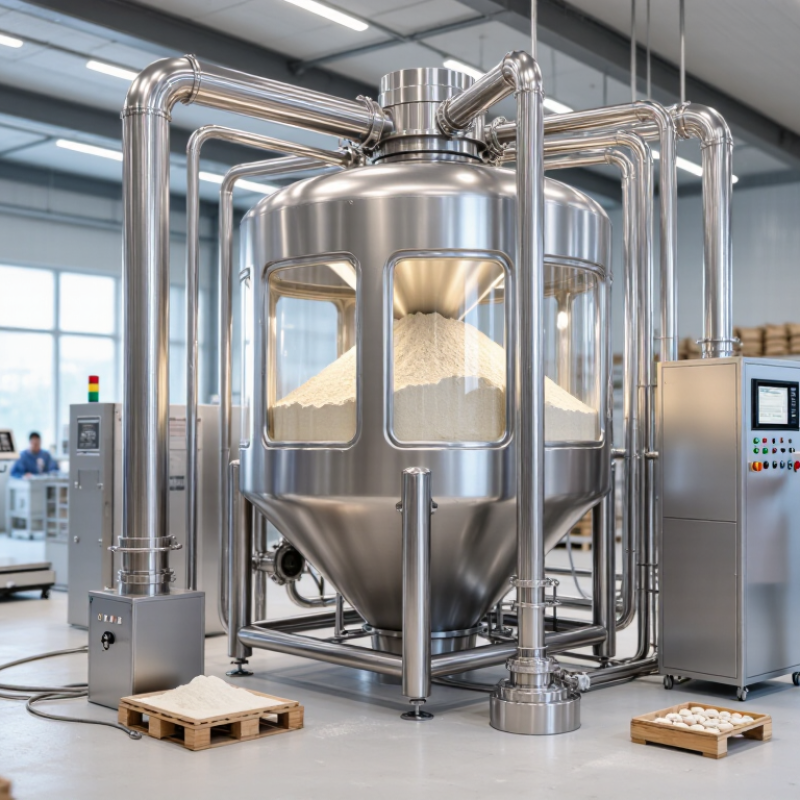
China Top Powder Mixture Machine Manufacturers for Global Buyers

What Powder Mixture Machines Do and Where They Are Used

Powder mixture machines blend dry particles into a more consistent batch. Common designs include ribbon mixers, paddle mixers, and rotating drums. Their moving elements lift, fold, or tumble powders, helping distribute ingredients with different particle sizes. Results depend on more than machine type. Fill level, mixing time, particle shape, and moisture all matter. A blend can look even yet separate during discharge or transport. Small details matter.

These machines serve food, pharmaceutical, cosmetic, chemical, and construction production. Food plants mix flour, spices, protein powders, and drink mixes; construction lines blend cement, fillers, and dry mortar ingredients. Pharmaceutical producers use controlled mixing for powdered formulations and excipients. Grand View Research estimated the global food processing equipment market at USD 55.7 billion in 2023, forecasting 6.0% annual growth through 2030. This broader market figure is not specific to powder mixers, but it indicates sustained investment in processing equipment. Buyers should check batch capacity, cleanability, discharge design, and dust-control provisions against their materials and workflow. Some batches still need adjustment. That is worth admitting.

China Top Powder Mixture Machines for Global Buyers: What They Do and Where They Are Used

Typical working fill levels for common powder mixer designs

Tumble mixers are commonly used for gentle blending of free-flowing powders; ribbon and paddle mixers suit a wider range of bulk blending duties. Fill levels are indicative operating ranges, not universal specifications. Actual limits depend on the mixer design and the material being processed.

Key Machine Types and Mixing Technologies

Powder mixture machines suit different materials and batch goals. Ribbon blenders use inner and outer helical blades to move powder in opposite directions. They work well for dry, free-flowing ingredients. Paddle and ploughshare mixers create stronger circulation, helping disperse heavier or mildly cohesive powders. V-blenders tumble material gently, which can protect fragile granules. High-shear mixers add an intensifier for breaking soft lumps or distributing small liquid additions. These designs are not interchangeable.

The 2024 Industrial Mixer Market report by Grand View Research valued the global industrial mixer market at about USD 2.5 billion in 2023 and projected 5.1% annual growth through 2030. That market figure covers more than powder equipment, so it signals broad demand rather than a powder-machine sales count. Buyers should compare particle size, bulk density, moisture, batch volume, and discharge needs. Ask for a trial using your actual powder; a neat demonstration with a substitute material can mislead. No design is perfect.

Tips: Check blend uniformity at several points in the batch, not just at the outlet. Confirm cleanability, access to seals, and residual powder after discharge. Record mixing time and fill level during trials. Small details matter.

How Chinese Manufacturers Design and Build These Machines

Chinese powder mixture machine manufacturers usually begin with the material, not the machine frame. Engineers ask about particle size, bulk density, moisture, batch volume, and cleaning frequency. These details guide the choice of a ribbon, paddle, or other mixing arrangement. A dense powder may need different blade clearance from a light, fluffy one.

Design work often combines 3D drawings with practical checks on motor load, shaft support, and discharge position. Contact surfaces may use stainless steel, with welds ground smooth where product can collect. Small details matter. A narrow corner can slow cleaning, even when the main chamber looks simple.

Manufacturers may build a trial unit or run a sample batch to check mixing time and discharge behavior. Results depend on the test material, so one successful run does not prove every recipe will perform the same way. Buyers can review drawings, inspection records, and test conditions before accepting a machine.

One detail is easy to miss: access for maintenance. A compact layout saves floor space, but can make a seal or bearing awkward to reach. That trade-off deserves a clear conversation during design.

Leading Chinese Manufacturers and Their Product Specialties

Chinese powder mixer manufacturers typically specialize by mixing action rather than offering one machine for every material. Grand View Research’s Industrial Mixer Market report estimated the global market at about US$2.64 billion in 2023, with projected growth through 2030. That demand rewards practical design: ribbon mixers handle routine dry blending, while paddle and ploughshare models suit heavier loads or materials needing stronger movement. V-blenders offer gentle tumbling for fragile granules. Fit matters.

Some suppliers focus on food-grade stainless-steel machines, with smooth internal surfaces and accessible cleaning points. Others emphasize high-shear mixers for powders that need rapid dispersion, or vacuum-capable systems for processes sensitive to trapped air. Ask for batch-size limits, motor specifications, and material-contact details—not just the advertised capacity. A catalogue can make these differences look simpler than they are. Small test batches may still reveal dead zones or uneven color.

Tips: Request a trial using your actual powder. Check whether discharge leaves residue around the outlet and whether cleaning access suits your routine. Record blend time and sample consistency. A polished specification sheet is useful, but it cannot replace process testing.

China Top Powder Mixture Machine Manufacturers for Global Buyers - Leading Chinese Manufacturers and Their Product Specialties

Product categories and specifications below describe common industrial powder-mixing equipment. Actual capacity, materials, configuration, and performance vary by model and supplier.

Machine specialty Mixing principle Suitable materials and applications Typical strengths Selection considerations
V-type blender A rotating V-shaped vessel repeatedly divides and recombines a free-flowing powder blend. Dry, free-flowing powders and granules used in pharmaceuticals, food processing, and chemicals. Gentle blending; relatively simple vessel design; useful where particle breakage should be limited. Less suitable for cohesive or damp powders without additional intensifier bars; check filling level and discharge design.
Double-cone blender A rotating double-cone vessel creates repeated tumbling and redistribution of its contents. Free-flowing dry powders and granules, including food ingredients and pharmaceutical blends. Gentle action and a relatively straightforward product-contact vessel that can be designed for cleaning access. Evaluate segregation risk when particles differ greatly in size or density; confirm discharge and cleaning requirements.
Ribbon blender Inner and outer helical ribbons move material in opposing axial directions within a horizontal trough. Dry powders and granules for food, feed, plastics, and general chemical processing. A widely used general-purpose design; can handle a broad range of batch sizes and blend formulations. Check residual material around the shaft and end seals, cleanability, loading method, and whether liquid addition is required.
Paddle mixer Paddles on rotating shafts lift, fold, and move material through a horizontal mixing chamber. Powders, granules, and some mixtures requiring liquid addition, including feed and industrial formulations. Flexible mixing action; certain designs support rapid discharge and can accommodate spray nozzles. Performance depends on paddle geometry and formulation; confirm whether the intended duty is dry blending or wet agglomeration.
Ploughshare mixer Plough-shaped tools create intensive movement and circulation; optional choppers can break up agglomerates. Powders and granules, including cohesive blends and formulations requiring liquid spraying or agglomeration. High-intensity mixing and options for dispersing added liquids or reducing soft lumps. Assess heat generation, wear parts, dust control, and whether the product needs gentle blending rather than intensive action.
Conical screw mixer A rotating screw conveys material upward along a conical vessel while material returns downward under gravity. Dry powders and granules, including products that benefit from controlled, relatively gentle circulation. Conical vessel geometry supports circulation toward the outlet; available configurations can accommodate varied process needs. Confirm discharge reliability for cohesive materials, access for cleaning, and the supplier’s design for dust containment.
High-shear mixer granulator A high-speed impeller mixes powder; a chopper and liquid addition may be used to form granules. Powder formulations intended for wet granulation, commonly in pharmaceutical and chemical processing. Combines intensive mixing and granule formation in one process vessel, subject to process design. Not a substitute for a gentle dry blender; verify process controls, cleaning validation needs, and downstream drying requirements.

For hygienic or corrosive service, buyers commonly compare product-contact material options such as stainless steel grades 304 and 316L, along with surface finish, seals, dust containment, and cleaning provisions. Material suitability should be confirmed for the specific product and process.

How Global Buyers Evaluate Suppliers and Choose a Machine

For global buyers, choosing a powder mixture machine starts with the material, not the brochure. Ask suppliers to test your actual powder, since flow, moisture, bulk density, and particle size can change mixing behavior. Request a trial with a defined batch size and mixing time. Watch for dead zones, dust escape, and material left around the discharge. Small details matter.

Supplier evaluation should cover more than quoted price. Compare contact-material specifications, motor data, control options, cleaning access, spare-part availability, and documented acceptance criteria. Ask how the machine handles your smallest and largest planned batches. A capable unit may still be awkward to clean or maintain at your site. Buyers can focus on capacity figures and overlook access clearance; it is an easy mistake. No checklist catches everything, so record open questions before approval.

Tips: Bring a representative sample and agree on measurable trial results. Check how quickly operators can reach seals and discharge points. Ask for operating instructions, equipment drawings, and a clear service response process. If a test result seems inconsistent, repeat it. Don’t guess.