
Blog
China Top Powder Pulverizer Manufacturer and Supplier?
Choosing a China Top Powder Pulverizer Manufacturer and Supplier requires more than comparing prices. It requires evidence, process knowledge, and careful technical judgment. A reliable supplier should explain how its machine handles materials such as herbs, chemicals, minerals, spices, and pharmaceutical powders. It should also provide clear data on capacity, final particle size, motor power, wear parts, dust control, and cleaning procedures.
Dr. Alban J. Lynch, a respected comminution specialist, has stated that “comminution is the largest consumer of energy in the minerals industry.” This observation remains important when evaluating a Powder Pulverizer. A machine that produces fine powder quickly may still waste energy or create excessive heat. That matters for heat-sensitive ingredients. It also matters for long-term operating costs.
Look closely at real manufacturing details. Does the supplier test your material before recommending a model? Can it show a working machine in a factory setting? Are the grinding chamber, screens, and contact surfaces made from suitable materials? Stainless steel may support hygiene, but the exact grade still matters. A supplier should also discuss noise levels, maintenance access, spare-part availability, and operator safety.
No supplier is perfect. I would remain cautious when a website promises unlimited capacity or uniform powder without test conditions. Reliable manufacturers admit limitations. They document performance instead of relying on impressive wording. This guide examines China-based Powder Pulverizer manufacturers through product quality, engineering capability, customization, after-sales service, and export experience. The goal is practical clarity, not an easy sales promise.
What Is a Powder Pulverizer and How Does It Work?
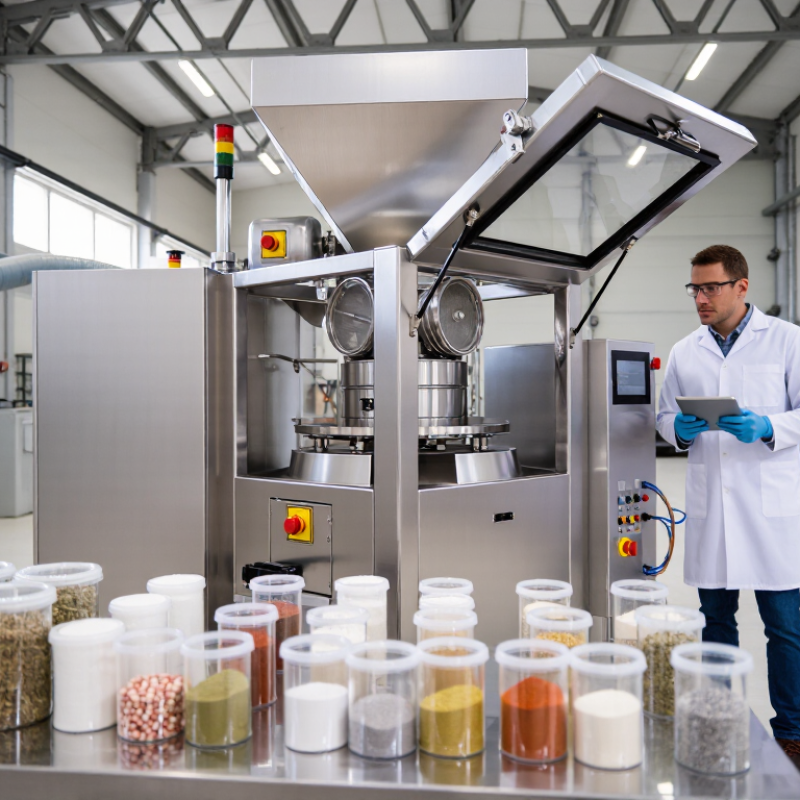
A powder pulverizer reduces solid material into finer particles through impact, compression, or shear. Inside a typical mill, a motor turns hammers, pins, or rotating discs. Material enters the grinding chamber, meets the moving elements, and exits through a screen once particles are small enough. The result depends on feed size, moisture, rotor speed, and screen openings. A dry, brittle sample may grind quickly; a damp one can cling to the screen. Small details matter.
The U.S. Department of Energy’s 2007 Bandwidth Study on Energy Use in the U.S. Mining Industry identifies crushing and grinding as major energy-consuming steps in mineral processing. That makes mill selection more than a question of maximum fineness: throughput, heat buildup, wear, and energy use also deserve attention. For example, a fine screen can produce a more uniform powder, but it may slow production or raise operating costs. Operators typically check particle-size distribution and inspect screens and hammers for wear. These checks help, though they do not remove every source of variation. A practical specification should state the target particle-size range, material characteristics, and required capacity—not simply ask for “fine powder.”
Main Types of Powder Pulverizers for Industrial Processing
Powder pulverizers differ by feed size, hardness, moisture, and required fineness. Hammer mills use impact force and handle brittle materials efficiently. Pin mills create finer powders through high-speed shearing. Jet mills use compressed air for ultrafine particles, often below 10 microns. Ball mills provide stable grinding for hard minerals, but they usually need longer processing time.
Classifier mills combine impact grinding with internal air separation. They can return coarse particles for another pass, improving size control. This matters in coatings, ceramics, chemicals, and food processing. A 2023 report from MarketsandMarkets placed the global grinding machinery market in the multi-billion-dollar range, with automation and fine-particle processing among key growth drivers. The exact value varies by research method, so buyers should inspect the report scope.
Energy deserves closer attention. The U.S. Department of Energy reports that compressed-air leaks can waste 20% to 30% of compressor output. Jet mills may therefore deliver excellent fineness while increasing operating costs. Plant audits should measure air pressure, feed rate, heat buildup, and final particle distribution. Moist feed can block screens. Hard feed can accelerate liner wear. I have seen specifications focus too heavily on micron size. That is a mistake. Throughput, cleaning access, noise, and maintenance time can matter just as much.
Key Applications of Powder Pulverizers Across Different Industries
Powder pulverizers support many industries by reducing dry materials into controlled particle sizes. Their value depends on material hardness, moisture, temperature, and final product requirements. In food processing, pulverizers handle grains, spices, sugar, herbs, and dehydrated vegetables. A fine, even powder can improve mixing, flavor release, and filling accuracy. Operators should monitor heat carefully. Excessive temperature may affect color, aroma, or nutritional quality.
In pharmaceutical production, pulverizers help prepare powders for tablets, capsules, and other regulated formulations. Particle size influences blending behavior, flowability, and dosage consistency. Equipment must be easy to clean, with suitable contact materials and documented operating procedures. Small differences matter. A poorly adjusted screen can create too many coarse particles or unwanted fines. Experienced technicians usually inspect samples during production instead of trusting settings alone.
Chemical manufacturers use powder pulverizers for minerals, pigments, resins, and specialty compounds. Construction material producers may process limestone, gypsum, clay, and similar inputs for cement or finishing products. Agricultural operations also pulverize dried plant materials and soil conditioners. Each application needs a different combination of speed, airflow, screen design, and feeding rate. There is no universal setting. In practice, moisture changes can reduce output unexpectedly, so testing real production material remains essential. Manufacturers and suppliers should provide clear specifications, safety guidance, maintenance support, and performance data based on actual operating conditions.
How to Choose the Right Powder Pulverizer for Your Materials
Choosing a powder pulverizer starts with the material, not the machine’s advertised capacity. Is your feed brittle, fibrous, abrasive, or sensitive to heat? These traits affect grinding action, wear, and particle consistency. Small details matter.
Define the target particle size and expected output per hour. A hammer mill may suit brittle materials, while a pin mill can offer finer, more controlled grinding for some applications. These are starting points, not guarantees.
Ask suppliers to test a representative sample and report particle-size distribution, throughput, and temperature rise. A single average size may hide uneven results.
Check how the machine handles moisture, cleaning, and wear parts. Damp feed can clog equipment, while abrasive material may shorten component life. If contamination matters, review contact surfaces and cleaning access before purchase.
Also consider noise, dust collection, and the space needed for maintenance. Not always obvious.
A specification sheet can look convincing, yet real material may behave differently. Share your actual feed conditions, including variations between batches, and compare test results against your production needs.
What to Look for in a China-Based Pulverizer Manufacturer and Supplier
China Top Powder Pulverizer Manufacturer and Supplier?
What to Look for in a China-Based Pulverizer Manufacturer and Supplier
Choosing a China-based pulverizer supplier takes more than comparing quoted prices. Check whether the machine suits your material, target particle size, and hourly output. Ask for test data using a sample similar to your actual feedstock. A clear specification should state motor power, contact materials, screen options, and expected maintenance intervals. Request drawings and a parts list, too. Small details matter.
Tips: Ask how the supplier checks rotor balance and verifies particle-size results. Confirm which wear parts are included and how quickly replacements can ship. If possible, inspect a running machine by video or arrange a factory visit. A polished presentation is not proof of performance.
Reliable suppliers answer technical questions with measured details, not broad promises. Ask about installation guidance, operator training, warranty limits, and after-sales response times. Get these terms in writing. Also review the proposed packing method and export documents before production begins. Even careful buyers can overlook one fitting or voltage detail. That is worth checking twice.
China Top Powder Pulverizer Manufacturer and Supplier? - What to Look for in a China-Based Pulverizer Manufacturer and Supplier
| Evaluation dimension | What to verify | Why it matters | Useful evidence or questions |
|---|---|---|---|
| Material compatibility | Confirm the pulverizer is suitable for the material’s hardness, moisture, abrasiveness, temperature sensitivity, and any combustible or reactive properties. | Material properties influence equipment selection, wear, throughput, product quality, and operating safety. | Ask whether the supplier can conduct a test using a representative sample and provide documented results. |
| Particle-size performance | Clarify the required particle-size range, distribution, and acceptable proportion of oversize or fines. | A stated maximum fineness alone does not show whether the machine can consistently meet the full product specification. | Request test reports that identify the material, operating conditions, sampling method, and particle-size measurement method. |
| Capacity and operating conditions | Compare quoted capacity with the intended feed material, target fineness, moisture level, and continuous operating schedule. | Throughput varies with material and process settings; a nominal rating may not represent actual production conditions. | Ask for capacity assumptions, power requirements, and expected output under conditions similar to your process. |
| Construction and wear parts | Review contact materials, component design, wear-part availability, and maintenance access. | Wear resistance and serviceability affect product contamination risk, maintenance frequency, and lifecycle costs. | Request material specifications, recommended inspection intervals, and a list of routine replacement parts. |
| Safety and dust control | Check guarding, interlocks, dust collection interfaces, noise considerations, and risk controls relevant to the material. | Powder processing can create dust exposure and, for some materials and conditions, combustible-dust hazards. | Ask for the equipment risk documentation and confirm that site-specific safety requirements are assessed before purchase. |
| Quality management and inspection | Understand how incoming materials, fabrication, assembly, and final equipment testing are controlled and recorded. | Traceable inspection records help buyers assess consistency and verify that agreed specifications have been met. | Request relevant quality-system certificates and inspection or factory-acceptance documentation; verify their scope and validity. |
| Customization and system integration | Determine whether the supplier can accommodate feed systems, classifiers, dust collectors, controls, and site layout constraints. | A pulverizer is often part of a process line, so interfaces and installation requirements affect overall performance. | Provide a process flow diagram and request an equipment scope, utility list, and interface drawings. |
| Technical support and spare parts | Confirm commissioning support, operator training, troubleshooting channels, documentation, and spare-parts lead times. | Responsive support and accessible parts can reduce downtime after installation. | Ask what support is included, how service requests are handled, and which parts should be stocked locally. |
| Commercial terms and delivery | Review the equipment scope, payment milestones, delivery schedule, packaging, shipping terms, warranty coverage, and exclusions. | Clear terms help avoid misunderstandings about what is supplied and who is responsible for each stage. | Compare itemized quotations and confirm the applicable delivery term, destination, warranty conditions, and acceptance criteria in writing. |
| Reference checks and verification | Assess relevant project experience and verify company, product, and certification information through appropriate independent channels. | Documented, comparable experience provides more useful evidence than broad claims or unverified promotional statements. | Request references for similar materials and applications, and confirm that any certificates or test documents match the offered equipment. |
Related Posts
-
What Is a Powder Pulverizer and How Does It Work?
-
What Is the Best Powder Pulverizer in 2026?
-
How to Choose the Best Mixing Powder Machine for Your Needs?
-
Why Choose the Right Mixing Powder Machine for Your Business?
-

How to Choose the Right Syringe Assembly Machine for Your Production Needs?
-
2026 Best Oral Thin Film Pouching Options for Packaging Solutions?