Why Choose Tableting Machines for Efficient Pharmaceutical Production?
In the ever-evolving world of pharmaceuticals, efficiency is crucial. Tableting Machines play a vital role in streamlining production processes. Dr. Emily Chen, a leading expert in pharmaceutical manufacturing, emphasizes, "The right machinery can transform production timelines and enhance consistency." This statement highlights the importance of choosing the right equipment.
Tableting Machines are designed to compress powders into tablets effectively. They reduce waste and increase speed. With advanced technology, these machines ensure precision in dosage and formulation. This results in higher quality products for consumers. However, selecting an appropriate machine involves challenges. Companies must assess their specific needs and production scales.
The landscape of pharmaceutical production is changing. Investing in Tableting Machines can significantly impact efficiency. Yet, the decision must be thoughtful. It requires a balance between investment costs and operational benefits. A well-informed choice can lead to growth and adaptability in a competitive market.

Benefits of Using Tableting Machines in Pharma Manufacturing
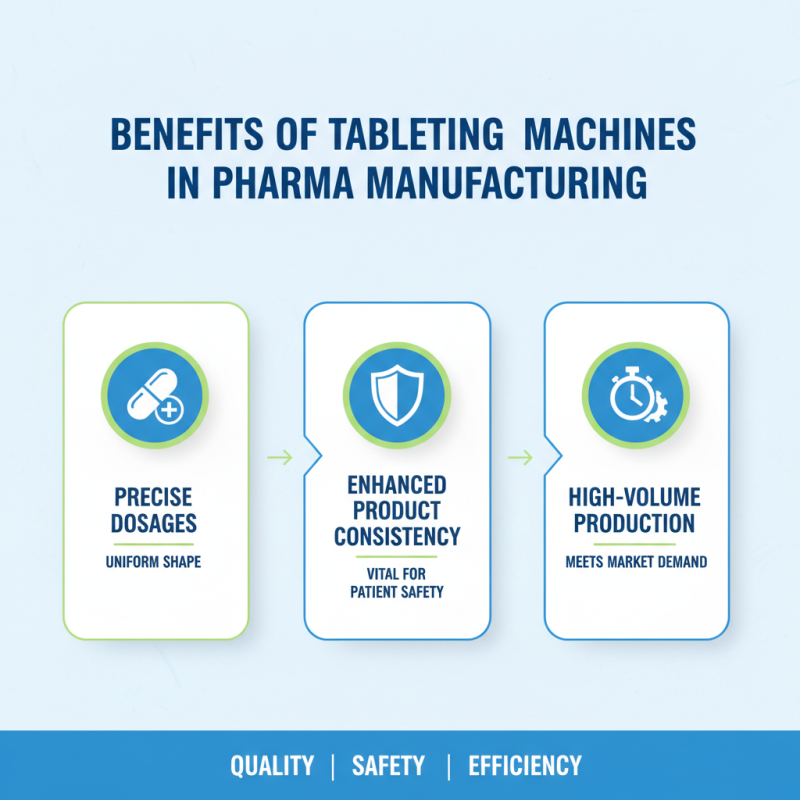
Tableting machines play a crucial role in pharmaceutical manufacturing. These machines create tablets with precise dosages and uniform shapes. This standardization enhances product consistency, which is vital for patient safety. When tablets are produced uniformly, it reduces the risk of over- or under-dosing. Additionally, the ability to produce large quantities quickly can meet rising market demands without compromising quality.
Efficiency is another key benefit of using tableting machines. Automated processes reduce manual labor and minimize human error. However, reliance on machinery requires diligent monitoring. Operators must regularly assess machine performance to ensure accuracy. Any malfunction can lead to production delays and financial losses. Thus, while these machines offer speed, they also require skilled personnel to oversee operations.
Tableting machines can use a variety of formulations. This adaptability allows manufacturers to create diverse products. However, each formulation may require specific adjustments in the tableting process. Understanding these nuances is essential for achieving optimal results. Manufacturers should invest in training for their teams to navigate these complexities effectively. This ongoing education fosters a culture of safety and quality.
The Role of Tableting Machines in Enhancing Production Efficiency
Tableting machines play a pivotal role in pharmaceutical production. They significantly enhance production efficiency. These machines automate the process of converting powdered ingredients into solid tablets. Automation reduces human error, leading to more consistent product quality.
With precise control over pressure and timing, tableting machines can produce tablets with varying shapes and sizes. This flexibility allows manufacturers to cater to diverse market needs. However, maintaining optimal settings can be challenging. Even slight deviations can affect tablet quality and efficacy, prompting the need for regular maintenance and calibration.
Incorporating advanced technology, some machines have the capability of monitoring tablet hardness and weight in real-time. This ensures that every batch meets stringent pharmaceutical standards. Despite these advancements, operators still need thorough training to handle the complexities involved. Continuous improvement in processes is essential for achieving maximum efficiency and reliability in production.
Why Choose Tableting Machines for Efficient Pharmaceutical Production?
| Feature |
Description |
Benefit |
| High Throughput |
Designed to produce large quantities of tablets in a short period. |
Increases production efficiency and reduces manufacturing time. |
| Consistent Quality |
Ensures uniform tablet weight and size through precise control. |
Reduces waste and enhances product reliability. |
| Automated Processes |
Incorporates automation for feeding, pressing, and ejection. |
Minimizes human error and speeds up production cycles. |
| Flexibility |
Can produce various tablet shapes and sizes easily. |
Adaptable to different formulations and market needs. |
| Reduced Labor Costs |
Lowers the need for manual labor in the production process. |
Cuts overall operational costs and improves profitability. |
Types of Tableting Machines and Their Specific Applications
Tableting machines have become essential in pharmaceutical production. They streamline the process of turning powders into tablets. Different types of tableting machines cater to various needs in the industry.
The rotary tableting machine is one of the most common types. It is suitable for large-scale production. These machines operate at high speeds, producing thousands of tablets per hour. However, they require precise calibration. Any slight error can lead to inconsistent tablet quality. On the other hand, single-station presses are designed for smaller batches. They offer more flexibility for varying formulations. This makes them ideal for research and development environments. Yet, their slower output can be a drawback for mass production.
Moreover, encapsulation machines serve a different purpose. They focus on filling capsules with powder or granules. These machines can be automated for efficiency. However, they may struggle with certain powder types. Some powders can be sticky or flow poorly. This presents challenges that manufacturers must address. Ultimately, understanding the specific applications of each machine can lead to better production outcomes.
Types of Tableting Machines and Their Specific Applications
Key Features to Consider When Selecting Tableting Machines
When selecting tableting machines for pharmaceutical production, understanding key features is crucial. The machine's efficiency directly impacts production speed and quality. Look for stability in compression. This ensures uniformity in tablet weight and strength, which affects efficacy and patient safety.
Another important feature is the machine’s versatility. It should handle various formulations, from powders to granules. This flexibility can help adapt to changing market demands. A user-friendly interface also matters. Operators need intuitive controls. Complex systems can lead to errors and downtime.
Consider maintenance requirements as well. Machines should be easy to clean and service. Regular maintenance checks are vital for longevity. However, some manufacturers overlook this, leading to unexpected breakdowns. A reliable supplier can provide necessary support. It ensures your machine operates at peak performance. Overall, evaluating these features can help secure a machine that meets both efficiency and quality standards in pharmaceutical production.
Future Trends in Tableting Technology for Pharmaceutical Industry
The pharmaceutical industry is rapidly evolving, and tableting technology plays a crucial role. Modern tableting machines are incorporating advanced software and automation. This integration enhances precision in dosing and improves production efficiency. As the demand for personalized medicine rises, machines are adapting to produce varied formulations quickly.
Future trends indicate a shift towards continuous manufacturing processes. This approach reduces downtime and waste. Continuous production lines offer more consistent tablet quality while managing costs effectively. Moreover, manufacturers are exploring 3D printing for tablets, paving the way for bespoke medication solutions. However, these innovations necessitate careful regulatory considerations, which can slow adoption.
Despite advancements, challenges remain. Many facilities struggle to keep up with technological changes. Training staff on new equipment can prove difficult. Additionally, maintaining quality control becomes increasingly complex with new technologies. Balancing innovation with efficiency and safety requires ongoing reflection and adaptation in the industry.