What Is an Oral Dispersible Tablet and How Does It Work?
An Oral Dispersible Tablet is designed to break apart on the tongue with little or no water. This feature can make medicine easier to take. It may help children, older adults, and patients who struggle with conventional tablets. The tablet does not simply “melt.” Saliva enters its porous structure, and the compressed particles separate rapidly. The dissolved medicine is then swallowed and absorbed through the gastrointestinal tract.
Regulatory standards matter. The European Pharmacopoeia describes orodispersible tablets as preparations that disperse in the mouth before swallowing. The United States Food and Drug Administration also emphasizes disintegration, dissolution, stability, and consistent dosing when evaluating oral products. These requirements explain why a pleasant mouthfeel alone is not enough. A tablet must disperse quickly while still delivering the labeled amount of active ingredient. Small details matter, including hardness, moisture exposure, packaging, and storage temperature.
The commercial opportunity is significant, although estimates differ. IQVIA’s Global Use of Medicines 2024 report shows continued demand for convenient oral medicines across aging and chronic-care populations. Industry analyses from Grand View Research and MarketsandMarkets also identify patient convenience and improved adherence as major drivers of orally disintegrating dosage forms. These reports should be read carefully. Their market definitions and forecasts are not identical. In real use, an Oral Dispersible Tablet may feel effortless, yet formulation remains technically demanding. A fragile tablet can crumble in a blister, while excessive strength can delay dispersion. Understanding this balance helps explain both how the dosage form works and why its design requires pharmaceutical expertise.
Definition and FDA Benchmark: Disintegration in 30 Seconds or Less
What Is an Oral Dispersible Tablet and How Does It Work?
An oral dispersible tablet (ODT) is designed to break apart in the mouth without chewing or a full glass of water. It may help people who have difficulty swallowing conventional tablets. The tablet meets saliva, softens, and disperses into small particles. Some formulations use porous structures, soluble excipients, or superdisintegrants to speed this change. The result feels quick, but it is not the same as instant drug absorption.
The FDA benchmark is central to this dosage form. In general, an ODT should disintegrate in 30 seconds or less during an appropriate in vitro test. This is a performance target, not a guarantee for every person or every dose. Test conditions use controlled equipment, fluid, temperature, and timing. A dry mouth, limited saliva, or incorrect tablet placement can change the experience. Thirty seconds matters.
Once dispersed, the medicine is usually swallowed with saliva and absorbed through the gastrointestinal tract. Only certain medicines meaningfully absorb through mouth tissues. Patients should follow the product instructions, especially when the tablet must remain on the tongue or avoid water. The 30-second figure can sound absolute, yet formulation science is less tidy. Tablet hardness, packaging stress, storage humidity, and patient technique may affect disintegration. Laboratory speed and real-world performance are related, but not identical.
Formulation Science: Superdisintegrants, Porosity, and Tablet Strength
What Is an Oral Dispersible Tablet and How Does It Work?
An oral dispersible tablet is designed to break apart quickly in the mouth without swallowing water. Saliva enters its pores, wets the compact, and helps release the active ingredient. The tablet may feel firm at first, then collapse into fine particles within seconds.
Formulation science controls this behavior. Superdisintegrants absorb saliva, swell, or draw liquid through narrow channels by capillary action. Their performance depends on particle size, concentration, and mixing time. Too little may slow dispersion. Too much can weaken the tablet or create a gritty mouthfeel. Porosity is equally important because open spaces help saliva travel through the tablet. However, excessive porosity can make tablets fragile during packaging and transport.
Tablet strength must therefore balance handling with rapid breakup. Compression force usually increases hardness, but it can reduce pore volume and delay disintegration. In practical development work, small changes in lubricant level or compression speed may alter the result. Testing should include dispersion time, mechanical strength, moisture exposure, and mouthfeel. A tablet that passes one test may still perform poorly in another. That is a useful warning. Formulators sometimes optimize a single number and overlook the patient’s actual experience. Even the accepted dispersion time can vary with saliva volume, temperature, and individual use conditions.
Oral Dispersion Step by Step: How Saliva Breaks the Tablet Apart
What Is an Oral Dispersible Tablet and How Does It Work?
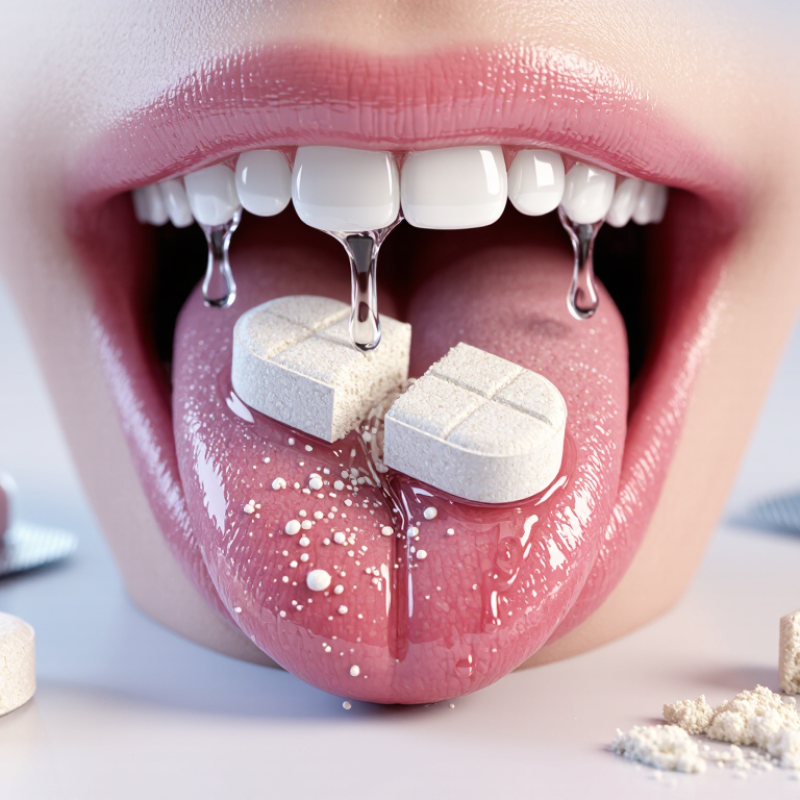
An oral dispersible tablet breaks apart on the tongue without needing a glass of water. Saliva starts the process within seconds. It wets the tablet’s surface and enters tiny pores between its particles. This movement is called capillary action. Water-soluble excipients then dissolve, while swelling agents expand and weaken the tablet structure. Gentle tongue pressure helps create a soft, uneven dispersion. The medicine can then be swallowed with saliva.
The process sounds simple, but real use is less exact. Saliva volume, dry mouth, tablet hardness, and placement can change the experience. The FDA’s Guidance for Industry on orally disintegrating tablets uses 30 seconds or less as a practical disintegration benchmark. The European Pharmacopoeia also describes rapid mouth dispersion and commonly applies a three-minute disintegration limit. These figures describe test conditions, not a promise for every person. A tablet may disperse quickly in testing but feel slower in a dry mouth.
Tips: Place the tablet on the tongue and let saliva soften it. Avoid chewing unless the instructions allow it. Do not crush or split it casually. If your mouth feels dry, ask a healthcare professional for suitable advice. Taste and texture can still be imperfect, even when the formulation meets its testing target.
Drug Release and Absorption: Performance Without Swallowing Water
An oral dispersible tablet is made to break apart on the tongue with little or no water. It offers a practical option when drinking is difficult, inconvenient, or unavailable. Place the tablet on the tongue and let saliva soften it. The tablet then disperses into a fine mixture. Do not chew or crush it unless the product instructions allow this.
Drug release begins as the tablet absorbs saliva. Special excipients help it separate quickly, while the active ingredient dissolves into the oral fluid. Most medicines are then swallowed and absorbed through the stomach or small intestine. This does not mean they enter the bloodstream instantly. A few formulations may absorb partly through the mouth lining, but this depends on the drug, dose, and tablet design. Water is unnecessary, but saliva still matters.
The experience can feel surprisingly fast. Sometimes it feels gritty. Dry mouth may slow the process, and taste can affect adherence. These details are easy to underestimate. Faster tablet disintegration does not always produce faster clinical action. Food, stomach conditions, metabolism, and the medicine’s formulation still influence absorption. Keep the tablet protected from moisture, because humidity may weaken its structure. If swallowing is painful or difficult, a pharmacist or clinician should confirm whether this dosage form is suitable.
Quality Testing Under USP <701>: Disintegration, Friability, and Uniformity
What Is an Oral Dispersible Tablet and How Does It Work?
An oral dispersible tablet breaks apart in the mouth with little or no water. Saliva wets the porous tablet, while its excipients help particles separate and release the active ingredient. The FDA’s Guidance for Industry: Orally Disintegrating Tablets states that these products should generally disintegrate within 30 seconds. In practice, a stopwatch, controlled temperature, and consistent testing technique matter. A pleasant mouthfeel alone proves very little.
USP <701> evaluates disintegration using defined apparatus, liquid conditions, and timing procedures. Analysts inspect each unit for complete passage through the test screen. A tablet may appear fast in the mouth yet perform poorly in the laboratory. That difference deserves attention. The method does not directly measure drug release or absorption.
Friability and dosage uniformity require related standards, not only USP <701>. USP <1216> commonly uses a 1.0% weight-loss limit for conventional uncoated tablets, although product-specific limits may apply. Excessive loss can create powder inside packaging and weaken dose delivery. USP <905> evaluates dosage-unit uniformity, commonly using an acceptance value limit of 15.0 at Stage 1. Analysts weigh units or assay their content, depending on the product and method. Small tablets create practical sampling challenges. Even a compliant batch can expose process variation if blending, compression, or moisture control is inconsistent. Reliable quality testing therefore combines disintegration data with friability results, assay evidence, and documented laboratory experience.
Oral Dispersible Tablet Quality Testing Under USP <701>
Key compendial and regulatory benchmarks for disintegration, friability, and dosage-unit uniformity. Values use different units and should be compared only within the same test category.
An orally disintegrating tablet is designed to break apart rapidly in the mouth, commonly within 30 seconds. USP <701> provides disintegration procedures, while friability and uniformity are evaluated under separate compendial standards.