How to Choose the Best Powder Mixers for Your Business
Choosing the right Powder Mixers can determine product consistency, production speed, and long-term operating cost. A mixer that looks impressive in a catalog may struggle with sticky powders, fragile particles, or uneven bulk density. The decision should begin with the material, not the machine. Particle size, moisture, flowability, batch volume, and required blending time all influence the final selection.
Industry data supports this careful approach. Grand View Research’s Industrial Mixing Equipment Market report identifies food, pharmaceutical, chemical, and other process industries as major demand sectors. MarketsandMarkets also highlights automation, hygienic design, and precise process control as important market drivers. These findings reflect a practical shift toward mixers that reduce waste while maintaining repeatable quality. Energy use matters too. The U.S. Department of Energy’s industrial efficiency resources repeatedly emphasize motor performance, operating loads, and maintenance as key cost factors.
Details matter most.
For example, a ribbon mixer may suit free-flowing powders, while a paddle or conical screw mixer can handle gentler blending requirements. Test data remains essential. Ask suppliers for trial results using your actual ingredients, target batch size, and cleaning procedure. Check discharge time, residue, dust control, validation support, and spare-parts availability. Hygienic welds and sealed bearings may appear minor, yet they can affect downtime and compliance.
There is no universal best choice. A technically advanced mixer can still be unsuitable if operators find it difficult to clean or control. Careful comparison is necessary, and some assumptions may need revision after pilot testing. The strongest decision combines published market evidence, supplier transparency, and hands-on process evaluation.
Define Powder Properties: Flowability, Bulk Density (0.1–1.0 g/cm³), and Cohesion
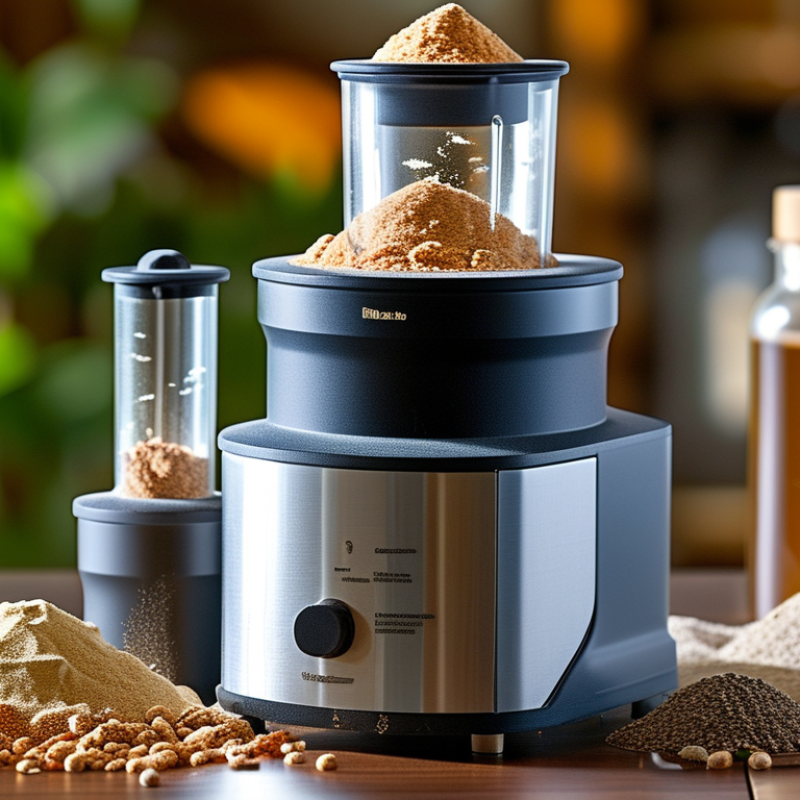
Choosing a powder mixer begins with understanding the powder, not the equipment brochure. In plant trials, I have seen similar-looking powders behave very differently. Flowability describes how easily particles move through hoppers, feeders, and mixer inlets. A free-flowing powder may charge smoothly, while a cohesive powder can form bridges or cling to walls. Small differences matter.
Bulk density also affects mixer capacity and motor loading.
Powders may range from 0.1 to 1.0 g/cm³, creating major volume changes at the same batch weight. A low-density powder needs more chamber space and may require gentle movement to prevent dust clouds. A dense powder can demand stronger drive torque, especially when it settles during charging. Measure it twice. Bulk density can shift after transport, vibration, or moisture exposure.
Cohesion is often the difficult variable. Fine particles, static charge, surface moisture, and irregular shapes can increase adhesion. I recommend testing flow behavior under realistic humidity and storage conditions. Observe discharge time, residue on the vessel wall, and changes in particle distribution. Do not rely on a single laboratory sample. That assumption failed in one trial because production material had absorbed moisture overnight. A practical mixer evaluation should compare fill levels, mixing time, cleaning effort, and batch consistency. Record both successful and poor results. Imperfect data still reveals where the process needs stronger controls.
Match Mixer Design to Batch Size, Fill Ratio (30–70%), and Throughput
How to Choose the Best Powder Mixers for Your Business
Mixer selection should begin with batch size, not equipment price. Grand View Research valued the global industrial mixer market at about USD 8 billion in 2023, reflecting rising demand for flexible processing. A mixer running near its practical limit may reduce blending quality. Keep the working fill ratio between 30% and 70% of vessel volume. Below 30%, ingredients may not circulate well. Above 70%, powders can form stagnant zones.
Match the design to the material. Ribbon mixers suit free-flowing powders and moderate batches. Paddle mixers handle fragile particles with less shear. Plow mixers can manage cohesive powders, but they often require higher power. Conical screw mixers offer gentle movement for sensitive formulations. Calculate throughput from batch weight, mixing time, discharge time, and cleaning intervals. The U.S. Energy Information Administration reported that industry consumed about 32% of U.S. end-use energy in 2023. Efficient cycles matter.
Tips: Test the actual powder. Lab results can mislead. Measure bulk density, moisture, particle size, and cohesion before purchasing. Ask for a trial using your target fill ratio. Record blend uniformity at the beginning, middle, and end of discharge. One overlooked issue is cleaning time; a fast mixer may still miss your production target. Recheck assumptions after the first month. Reality is usually less tidy than the spreadsheet.
Compare Mixing Performance Using Blend Uniformity Targets Below 5% CV
How to Choose the Best Powder Mixers for Your Business
A suitable powder mixer should support a blend uniformity target below 5% coefficient of variation (CV). This target is demanding, but practical for many controlled powder processes. The FDA’s Process Validation guidance recommends statistical monitoring during routine production, not one-time qualification alone. Therefore, compare mixers using repeated trials, not a single impressive result.
Test the mixer with your actual powder. Include differences in particle size, density, moisture, and flowability. Collect samples from several locations, including the center, wall, top, and discharge point. Measure assay results, then calculate CV for every trial. A 3.2% CV may look excellent. It can still hide segregation during discharge. That assumption needs testing.
USP General Chapter <905> uses an acceptance value of 15 for dosage-unit uniformity, but this is not the same as a blend CV limit. Keep these criteria separate. WHO Technical Report Series 1019, Annex 3, also emphasizes representative sampling and documented process control. Ask suppliers for raw trial data, sample maps, mixing time, fill level, and cleaning results. Review the weak runs, too. They reveal more than the best run. A mixer that reaches below 5% CV consistently, across realistic load conditions, offers stronger evidence than one that performs well only at full capacity. Do not overlook scale-up. Mixing behavior can change sharply when batch volume, powder cohesion, or operating speed changes.
Specify Hygienic and Safety Compliance: GMP, ATEX, and 3-A Standards
How to Choose the Best Powder Mixers for Your Business
Choosing a powder mixer starts with the product, but compliance determines whether it survives an audit. The World Health Organization estimates that contaminated food causes 600 million illnesses and 420,000 deaths globally each year. Hygiene is not cosmetic. Under GMP principles, specify smooth product-contact surfaces, crevice-free welds, full drainage, and documented cleaning validation. Confirm allergen-control procedures before approving the mixer. A polished surface alone proves little.
ATEX compliance becomes critical when powders can form combustible clouds. The U.S. Chemical Safety Board reported 281 combustible-dust incidents between 1980 and 2005, causing 119 deaths and 718 injuries. A mixer should match the site’s hazardous-zone classification, dust-group requirements, temperature limits, and ignition-protection method. Request test data for Kst and Pmax values, rather than relying on generic powder descriptions. Check grounding, bonding, interlocks, pressure relief, and inspection access. Small details matter.
For dairy and other hygienic processing, 3-A Sanitary Standards emphasize cleanability, drainability, and hygienic construction. Ask whether the exact mixer configuration meets the relevant standard, not merely whether the supplier supports it. Certificates must match the contact parts, seals, agitator, and discharge valve. During factory acceptance testing, inspect dead zones with a flashlight and verify cleaning coverage. This is where specifications become practical. Paperwork is not proof. A common mistake is accepting a standard certificate for a modified machine; that assumption deserves challenge.
Evaluate Total Cost Through Energy Use, Cleaning Time, Maintenance, and ROI
How to Choose the Best Powder Mixers for Your Business
A mixer’s purchase price can hide its real cost. The U.S. Department of Energy reports that motor-driven systems use 50–70% of industrial electricity. This figure is not mixer-specific, but it shows why motor efficiency deserves careful review. Compare power ratings, batch size, mixing time, and annual operating hours. A lower-wattage machine may consume more energy if it needs longer cycles. Measure actual output, not brochure promises.
Cleaning time affects labor, water, production scheduling, and contamination control. Record the minutes needed to empty, open, wash, inspect, and restart each mixer. Hygienic designs with smooth surfaces and fewer powder traps can reduce repeated manual work. Maintenance matters too. The DOE’s Operations and Maintenance Best Practices Guide indicates that preventive maintenance can reduce costs by roughly 12–18% compared with reactive maintenance. Still, real savings depend on training, spare parts, and service access. We often underestimate small delays.
Tips: Build a five-year cost model. Include electricity, labor, water, cleaning agents, replacement parts, downtime, and expected resale value. Calculate payback using measured production data. Test a sample powder before buying. Some powders bridge, cling, or generate dust differently. That mistake can distort ROI. Track energy per finished kilogram, cleaning minutes per batch, and unplanned repair hours for three months. Then compare mixer options using the same production conditions.
How to Choose the Best Powder Mixers for Your Business - Evaluate Total Cost Through Energy Use, Cleaning Time, Maintenance, and ROI
Calculation basis: Illustrative industry benchmark values for a 500 kg batch. Annual calculations assume 1,200 batches, an electricity rate of $0.12 per kWh, cleaning labor at $28 per hour, and five-year ownership. Maintenance is estimated at approximately 4–5% of purchase and installation cost per year. ROI and payback compare each option with the ribbon mixer baseline and exclude financing, depreciation, product losses, downtime, utilities other than electricity, and validation costs. Actual results depend on powder properties, batch frequency, cleaning procedures, labor rates, and equipment configuration.